What does the user need in this moment?
TL;DR
Attune supports couples in different moments — from private reflection to conflict, repair, and long-term growth.
I worked across the product to define a clearer interaction model, create stronger privacy and consent boundaries, simplify complex shared flows, and build a reusable system that could survive a major development-team change.
The biggest lesson was that designing AI was less about what it should say and more about what role it should have in each moment.
Overview
Attune is an AI-powered relationship app for couples.
I joined after the main product and modules had already been defined. My role was to help turn those pieces into one clear experience across the relationship modes, assessments, safety flows, shared sessions, and design system.
The challenge was not adding more features. It was making very different emotional moments feel like they belonged to the same product.
The problem
Attune already had a lot of functionality.
But a private conversation with AI, a conflict between two partners, a relationship assessment, and a crisis moment cannot all behave the same way. We needed to answer three questions:
Is this experience private or shared?
What role should AI play here?
Without those answers, the product risked feeling like the same chatbot repeated across different screens.
Goals
Make the product easier to understand
Help users quickly know which experience fits what they need.
Design AI around context
Change the role of AI depending on whether someone is reflecting alone, reconnecting, or talking with a partner.
Build trust
Make privacy, consent, safety, and shared information clear throughout the experience.
Design process
Define the product model
Before designing the visuals, I needed to make a structural design decision.
I defined what kind of relationship support each mode represented and whether it belonged to one person or to the couple. This private/shared distinction became the foundation for the rest of the product.

Reflect
I need to understand what I am feeling.

Repair
I need to calm down and process what happened.

Resolve
We need to work through something together.

Refine
We want to keep strengthening the relationship.
This helped establish a simple product model:
The modes are connected, but they are not a required sequence.
Make the modes feel connected
A simple solution would have been four cards. I moved away from that because it made the modes feel like separate features.
Instead, I designed them as full-screen spaces users could move between. Each mode has its own mood, copy, and visual treatment, while the same navigation keeps them connected.
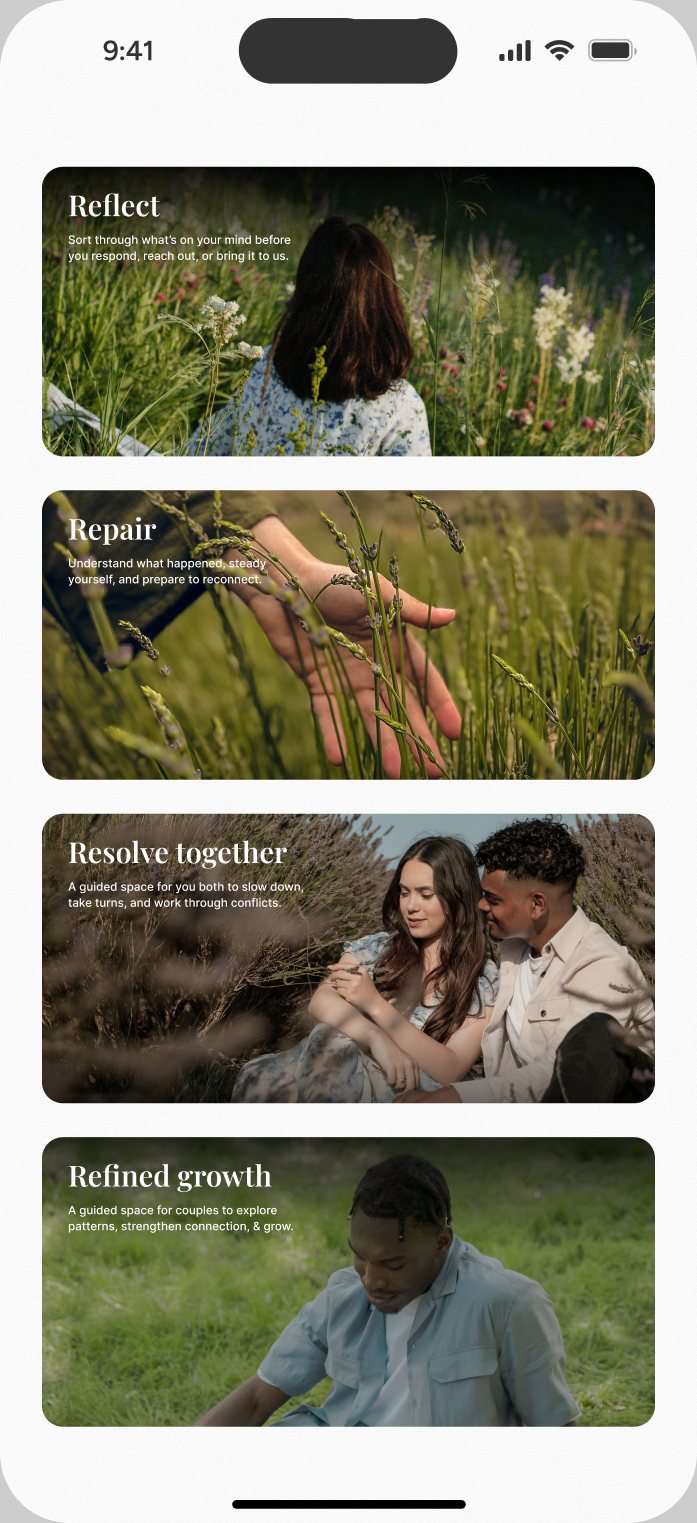
The four modes
01 / 04 · Private
Reflect
Reflect is a private space where users can talk through what they are feeling before deciding whether to act on it or involve their partner.
I kept the layout close to familiar AI chat patterns, with text, voice, and starter prompts all easy to access. That reduces learning and keeps the focus on processing the issue itself.
02 / 04 · Private
Repair
Repair is for after conflict, when the user may still feel activated and is not ready to reconnect yet.
The flow starts with a body check-in and short grounding exercise, then moves into AI-guided reflection and optional preparation for reconnecting with a partner.
03 / 04 · Shared
Resolve
Resolve is a shared mode for couples working through an active conflict with AI guiding the conversation.
It starts with mutual consent and shared ground rules, then uses turn-taking, protected speaking time, and AI clarification checks to keep the discussion balanced.
04 / 04 · Shared
Refine
Refine is for couples who want to keep working on their relationship even when there is no active conflict.
Unlike Resolve, it is more open-ended. Couples can schedule a session, repeat it over time, and work through guided prompts or small activities together. I also added light AI interventions, like appreciation prompts and focus warnings, to keep the conversation useful without taking it over.
If the conversation starts becoming too intense, the app can suggest moving into Repair instead.
04
Refine
Prototype placeholder
Turning points
When I realised the safest AI action was sometimes to stop
One of the hardest questions came from the Safety flow. What should happen if someone says something that is bigger than a relationship app should handle?
Instead of asking the AI to keep the conversation going, we designed it to pause the session, check on the user, and surface real-world crisis support.
The standalone Safety area also gives users access to region-aware resources and makes it clear that Attune is not a crisis service.
01
Image placeholder
02
Image placeholder
03
Image placeholder
When the development team changed mid-project
Partway through the project, the client replaced the development team and the handoff timeline suddenly became much tighter.
That changed the importance of the design system. What had started as good organisation became essential.
We went screen by screen, identified repeating elements, checked whether a component already existed, and used variants instead of creating duplicates.
We also organised the product module by module so a new team could understand what to build without reopening every design decision. In total, the handoff covered roughly 169 screens.
The part I cared about most
Designing where AI should stop
The most important design decision was not about what AI should say. It was about knowing when AI should no longer be the right support.
Attune includes a safety layer that can pause a live session when something serious is disclosed, surface region-aware crisis resources, and guide the user toward real-world help.
01
Session paused
Image placeholder
02
Safety check
Image placeholder
03
Crisis resources
Image placeholder
04
Continue when ready
Image placeholder
The user can continue when they are ready, but the product does not try to keep them engaged at all costs.
That principle shaped a lot of the wider experience:
- Private conversations stay private.
- Partners consent before shared sessions.
- Difficult conversations have structure.
- Sessions can pause instead of forcing resolution.
- Real-world support takes priority when needed.
Designing the modes
Each mode uses the same product language, then changes its pacing and interaction rules to fit the moment.
02
Private · after conflict
Repair slows the moment down
Repair begins with a body check-in, moves through grounding, then opens into AI-guided processing and an optional invitation to reconnect with a partner. In a charged moment, fewer choices help the experience feel supportive rather than clinical or task-driven.
- 01Body check-in
- 02Grounding
- 03AI conversation
- 04Reconnect invite
- 05Optional summary
02
Repair flow
Mobile screens / prototype placeholder
03
Shared · active conflict
Resolve structures a difficult conversation
Resolve is a shared mode where both partners work through an active conflict with AI facilitating. The interaction needed to support fairness, consent, pacing, and context from both sides.
APartner A
AIFacilitator
BPartner B
- Both partners consent before the session begins.
- Turn-taking gives each person uninterrupted speaking time.
- Prompts adapt to what both people have already said.
- The session can pause or end without forcing a resolution.
- Summaries and follow-up actions remain consent-based.
03
Resolve session
Shared-session prototype placeholder
04
Shared · ongoing growth
Refine is designed for repeat use
Refine supports couples who are not in active conflict but want to keep working on the relationship. A one-off “start now” action was not enough, so the experience became a sustainable shared ritual.
- 01Pick a time
- 02Repeat weekly
- 03Set reminder
- 04Notify partner
04
Refine scheduling
Scheduling states / motion placeholder
Personalization & safety
Personalization needed to feel useful without becoming invisible or intrusive.
Personalize the wider product
Attachment style, love language, conflict style, emotional sensitivities, and relationship history can improve later experiences. The value is not the quiz—it is how those results quietly shape future support.
- Intro
- Questions
- AI profile
- Result
- Consent for joint use
Know when AI should stop
Safety exists both as a standalone space and inside live sessions. When a disclosure is bigger than the product should handle, the AI pauses and directs the user toward appropriate real-world support.
- Sensitive disclosure
- Pause
- Check danger
- Surface local help
- Continue only if ready
05
Assessment + safety
Screen comparison placeholder
Designing the system
The work had to survive a major implementation change—not just look complete.
Midway through the project, budget pressure led to a full development-team change. Documentation became a hard delivery requirement, and system thinking became the difference between a collection of screens and a product another team could continue building.
~169
frames organized into module-level prototypes and documentation
Key iterations
Made ownership clearer
Replaced long labels with partner identity and “Scheduled by [Name]”.
Supported long-term use
Expanded one-off actions into repeat, reminder, reschedule, and notification states.
Protected privacy
Replaced manual sharing with consent-based use inside joint sessions.
Protected tone and accuracy
Locked accurate screens first, then added motion to priority transitions.
Reduced duplication
Moved from ad-hoc creation to a screen audit and variant-first approach.
06
System + handoff
Component library / documentation placeholder
Outcome
The project moved from a set of existing modules toward a more coherent product system.
The final direction created:
- Clearer roles for each relationship mode.
- Stronger private vs. shared boundaries.
- Different AI behaviours for different emotional contexts.
- Explicit consent in sensitive flows.
- A more useful Safety layer.
- Repeatable patterns across the product.
- A cleaner system for development and handoff.
What I learned
Attune changed the way I think about AI products.
At the start, it was easy to focus on questions like:
What should the AI say?
By the end, the more useful questions were: